The bad thing about schedules

It’s been a busy day and my morning blew apart. I’ve always heard that having too rigid a schedule is a very fragile way to live.

Your schedule breaks and so does your flow. Your efficiency and good vibes bout the day of work often get too hooked to a schedule. I do this almost every day.

Anyway, I’m falling asleep at my office getting this blog post ready for tomorrow morning. I don’t want to write anything. I just want to go to sleep. But I’m showing up just to keep the blog post streak alive.

Better stuff to talk about and think about tomorrow when my mind ain’t fried and my eyes are wide and clear.

Don’t worry about greatness

The greatest of legends often aren’t elevated to that status until years or decades after they die. Many great figures are controversial while they live.

With death dies the flaws and the things we criticize, but onward live the good things that cement one as a great figure.

Think about this concerning your work. Focus on working hard and let people decide your greatness later–probably after you die.

Better tools, worse skills

My electric carving knife broke the other day and last night I was forced to use the old fashioned carving knife like my predecessors have been doing for thousands of years.

I could tell that my skills and comfort carving with this knife wasn't as good as even a few months ago.

I don’t think I’m going to use that electric knife anymore. I’ll keep my skills sharp with the old knife and enjoy the process.

How many advanced tools do we have today that have allowed us to have worse skills? I’m looking for areas in which I can cut back and sharpen skills and lessen my dependence on tools.

Time to be less faithful

We’re all so attached to our opinions. It makes it much harder to grow and shift and learn new things.

I’m not saying you should detach from fundamental known truths. I’m talking about things of which you’re not quite the expert you might think you are or those things that are subjective.

We have the overwhelming need to be faithful to our opinions and we hold onto to so much that is feeble at best.

Time to be less faithful to that stuff and be more of a heretic in the eyes of the world. Someone who lays down old opinions as you learn new things. Not blanket open-mindedness, that’s dumb and leads to complete instability. I’m talking about humility and flexibility.

May we dignify losing?

As you work your way through life blunders happen and urgent events wreak havoc on your life in the most unpredictable of ways.

In theory, the one thing you can control in life is your attitude and response toward these events.

The ancient heroes we admire were dignified and measured in victory and defeat and therein they dignified the win or loss.

Their dignity through hardship renders them valuable and respectable, not the outcome of the struggle.

Maybe if we were more dignified in our approach and response day-to-day, we could be more heroic in both our wins and losses in life.

Science and fashion of the past

We laugh at the old fashions. We deride them as “dated.” It’s hard to believe we ever paid money for that dress, bow tie, or that hairstyle. We’re positively baffled by those decisions.

We laugh at the science and medicine of old. The earth’s edges that ships could fall off, the heart being the source of heat for the human body, the blood-letting procedures of earlier times, and the earth sciences were intriguing, to say the least.

Yet while we scoff this who have gone before, we enshrine those who are present now.

Humans haven’t changed all that much. Future generations will look back with more than a curious smirk (they will laugh) at the things we believe in now and some (or maybe “much”) of what we hold dear in the field of science.

Science and fashion; celebrated at the moment and ridiculed at the next.

The king might hear

Very often, your work may feel like you’re shouting down an empty hallway.

How exactly is this furthering your career? Is the time you’re spending on that personal project worth it? What if only ten people see it?

Depending on what you do for work, this is something you will most likely feel at some point.

The reason to continue working at it is that you don’t know who is listening. The king might walk by that hallway, hear your message, and change your life or business.

So keep creating, shouting, sharing, and don’t get discouraged!

P.S. I am somewhat aware of the divide between the rational and emotional brain. It’s easy to understand this, but it won’t help any of us feel that much better because the emotional brain doesn’t care about the stuff that makes sense. Still, it feels good to write about it–even if that doesn’t make much sense.

Too much data, too much noise

We have so much data at our fingertips these days.

Our smartphone tells us how many steps we’ve taken.

Our Apple watch gives us a heart rate reading anytime we wish.

Our financial tracking software shows us realtime in and out movements of money and how the business is faring in each moment.

We can track every tick of the stock market.

I can see incredible amounts of live, up-to-the-moment analytics about videos I post on YouTube.

Even when I ride my bike, I can see how many watts of power I’m outputting displayed on my bike computer as I ride, it connects wirelessly to my heart rate monitor and displays that BPM number, I can see my speed, how many feet of elevation I’ve climbed, my average MPH and all these numbers are constantly updating every single moment.

Data, data, data everywhere we look.

But if we take each piece of data based solely on the piece of data we saw just before it and make our judgment, we will transform our lives into jagged and over reactionary lives of misery. Always a slave to the whims of the noise of data.

So what if my heart rate is 2BPM higher than normal. I’ll be concerned if it’s 20BPM higher. So what if the business is running at a net loss today, weekends are when we make our money. So what if the daily views are down 3%, tomorrow they could be up 12%.

Instead of hanging on the moment by moment noise of data, watch for the big changes only. Ignore the small stuff.

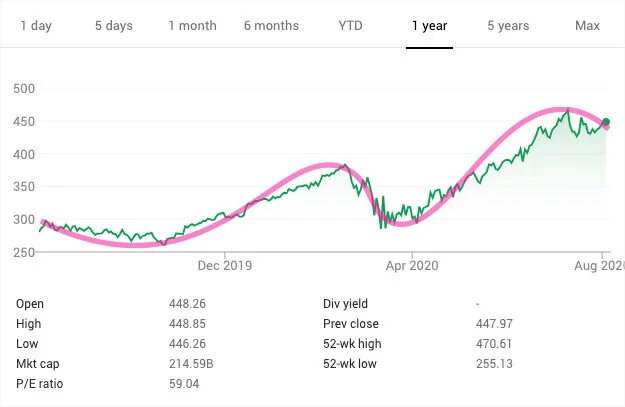
jagged versus smooth graph

If you draw a graph and mark some business or personal data change every hour, you will end up with a jagged bumpy graph line (representative of the turmoil you feel by constantly examining this data stream), but if you ignore all the little changes bu drawing a smoothed line that generally follows the course of the jagged graph line, you will see a more simple and smooth output of the data.

One that ignores the noise and presents a less volatile picture of our data.

The last of yesterday

I spend the last moments of each yesterday planning for the first few moments of each today.

I’m warmed up and thinking is easier right before I go to sleep than the moments after I wake up.

In doing this for quite some time, I’ve observed that it helps the efficiency of my days like an aircraft that refuels in mid-air.

He maintains speed and momentum (for the most part) whereas the pilot who lands to re-fuel must start from a dead stop, take off, and reobtain altitude and momentum.

Spend the last of yesterday planning the first of today.

Pacing

Pacing is pretty important. When you sprint it’s awesome because you’re beating everyone around you. But then you blow up and the guy who paced himself cruises by you at his own pace.

Resist the urge to sprint all the time. It always catches up to you. Always. Pacing never fails and your future self will thank you for it.

What’s worth reading?

The world is so fast these days. Why have you stopped to read this? Or have you stopped to read this?

Probably not. You haven’t even made it to the second line of my post.

Because there are two dozen tabs open and at least three social media platforms to continue scrolling through.

We scroll past more than our parents could have read in a lifetime.

What is the endless scroll doing to us? No time to think, no time to say something profound, no time to consider something profound.

I think we should be looking for ways to limit or stop the scrolling and spend more time on the few things we do see instead.

Which is more valuable, reading 35 headlines, or reading one article?

Fooled by “Randomness”

In a pivotal moment on June 4th, 1942, at the Battle of Midway, American torpedo planes are finishing up their (very unsuccessful) torpedo runs at the Japanese carriers attacking Midway atoll.

Moments after these planes have been shot to pieces by the Japanese “Zero” fighter planes, three squadrons of U.S. dive bombers happened to emerge from the clouds at the same time and at the perfect altitude to attack.

These squadrons were traveling in different directions searching for the Japanese fleet and “by chance” happened upon them.

These aircraft managed to sink three of the four Japanese carriers due to the timing of the attack and lack of prepared defense from the Japanese (they’d expended ammo and time on the American torpedo planes and couldn’t hold off the dive bombers.)

By the end of the Battle of Midway, the Japanese had lost 3,000 men, 4x aircraft carriers, 1x heavy cruiser, and about 250 airplanes.

This marked a decisive end to the Japanese offensive in WWII. They spent the rest of the war defending and slowly losing islands throughout the Pacific.

We could be fooled into believing this random moment and convergence of three squadrons of aircraft was a brilliant plan and that we have the best minds and admirals and all the fuzzy stuff that feels good, but the reality is that it was an unpredictable moment that happened and changed the entire war.

How often in life and business do we ascribe things to our cunning or skill when it’s more a matter of happenstance and something out of our control?

Feeling richer

Move out of the luxury apartment and into a townhome and you’ll feel pretty rich.

You won’t be competing with the guy upstairs who takes a helicopter to work while his wife takes the Bugatti downtown to shop at the high-end shops all day.

They say that once your basic bills are paid, more money doesn’t make you happier. Maybe that’s because of this treadmill effect where a person makes money, they move to a higher-end neighborhood and become poor again.

As you make more, you expand the vacuous space which you fill with money. It’s the vicious cycle of materialism worked out into the flesh.

The stress of the problem you don’t have

You’ve been around that person who is always worried about the big thing about to happen. The tragedy that is always lurking around the corner.

The energy wasted and the life stunted by worrying about the problem that has not yet occurred.

Who cares whom you think will win “on paper” when there is still the game to play?

I understand it’s not that easy and usually, the fear of the problem-to-be is irrational, but it feels good to write this note to myself as well.

It’s hard to do logic

It’s not hard to talk about being logical. It’s easy to explain the rational thing. It’s fun to explain how brilliant we are and how much sense we make. It's obvious (most of the time) what we need to do.

I think it’s because we like to voice logical and rational ideas, but we’re not so interested in following through with them.

This would explain how we know what we should do, but we never actually do it.

You’re only comparing yourself to the survivors

We have survivorship bias because we see the survivors. They won and are winning and that’s what we see. Unfortunately, it’s also what we compare ourselves to.

The point we miss is that we have climbed over many who have tried and failed, but we’ve made it this far. If we stopped comparing ourselves to the survivors and big winners, we’d be doing even better.

Never forget that the sample size against which you’re comparing yourself is bad data. You only see the winners, so don’t beat yourself up as much and keep pounding.

The ones who don’t hesitate

I always find myself searching for where to begin instead of just starting.

The beauty of starting is that the end will come when the time is right.

I’ve always been a little envious of people who have an idea and see no stumbling block to just going and doing it.

They see something and do something. They think something and make something. They don’t do it tomorrow, they do it right now.

Most of the time you hold you back, and all the time I hold me back.

To the ones who don’t overthink it and chomp at the bit to get it done, my hat is off to you. I’m working on it.

We ignore this very important thing about history

There is a well-known saying that “if you ignore history, you’re doomed to repeat it.”

The interesting thing that is often overlooked in history, however, is that the big lesson of history is that things that have never happened before will happen. They always have.

These unknown and unexpected events change everything. That is a big lesson we can learn from history.

Don’t play Russian-roulette

It’s okay to take losses. It is preferable for your business (and your sanity) for your business to lose small amounts of money often if it can make a large amount every so often.

The problem with losing is when it’s easy to get wins and easy to make chunks of money, but there is a chance you lose it all if the markets turn bad (or some other catastrophic event takes place.)

That’s Russian-roulette. Highly likely that the bullet is not in the chamber, but if it is, you lose everything.

Don’t play Russian-roulette.

The drift

Contrary to what we might think, it's not the big changes that contribute to the degradation of good practices and habits in our life. It's the drift.

The drift is like that insidious snake that creeps in and slithers down your throat and convinces you that it's no big deal to skip a day at the gym (it's only going to happen just this once, right?) or to break your sleep schedule just this once, or to avoid this or that piece of work.

The drift sets you up for the big failures and all the devil asks for is a toe-hold. Then he's ready to jump on your back with a knife out to do his dirty work.

When the "little" things aren’t important convincing arguments pop up where you would have once been steady as a rock. Fight against the drift and stand your ground even on the little stuff.