Two keys to speaking and sharing information

As a content creator and educator online, I have a great interest in the methods that are used to convey information in interesting and engaging ways. Two of the primary thoughts that I run into are:

  1. Speak and teach in an approachable way. Don’t be too technical with an audience of beginners and bore them, but don’t be overly basic with an audience of experts and offend them.

  2. How you speak and convey information is just as important as what you’re speaking about. The best story ever told, told in a dry and uninspiring way will leave the whole room bored to tears.

Whenever you’re able, learn who your audience is so you can share appropriate information in a way they can consume best. And speak in a way that is not scripted (even if your speech is written beforehand!) Speak with inspiration and passion, as though the words are coming to you in that very moment. This gives weight to your story and makes everything feel more immediate to the audience. It will also cause everything you say to have more impact and draw in those who are listening.

Wear out your shoes

Our world is obsessed with self-betterment. It’s part of why I write these blog entries every day. I’m practicing thinking about ideas I see, hear, and read about and regurgitating them into these short articles.

Self-betterment often leads young people into the trap of focusing all of their effort on optimization. The adage “Work smarter, not harder” is misapplied by practically everyone and is very dangerous to any good work ethic.

Hard work is the price of admission. You can’t get smarter unless you’re working. Like trying to steer a ship, it must be moving first.

Rather than trying to save my energy and time as if I’ll get it back later, I want to do the hard work first and figure out working smarter once I know how the work feels.

Wear out your shoes, not your sheets.

Adversity makes the man

If adversity makes men, and property makes monsters, why do we all want prosperity? Probably, because prosperity is comfortable. But what does that then say about comfort? The dichotomy of discomfort so often being so good for us is interesting.

Disappointment

Disappointment is a harsh reality that sets in and forces you to readjust your view of the world and your assessment of the situation. Adjustments are needed and disappointment is the emotion that helps you make the required changes.

We can't let difficulty and disappointment drown us. Perspective is the road that is elevated beside the ditch of disappointment. With perspective we can observe and take good from disappointment. We can also avoid the traps disappointment would have us believe.

This trap is that disappointment is certain and permanent. But it's not permanent.

Where there is no end to love, there is no end to grief, but that unbounded love is reserved for a precious few things in life. Most of what disappointments us doesn’t get our unbounded love, so we should understand that the grief of it will pass quickly.

Despair and blind optimism are opposite one another and we have to walk the road of wisdom between both. It helps to work while you walk that road. Walking and thinking, without working, seems to push us into despair or blind optimism (which only sets you up for more disappointment.)

Try not to linger and fall for the trap that disappointment is permanent.

"Courage isn't having the strength to go on. It is going on when you don't have the strength." –Napolean Bonaparte

Modern marketing

Marketing has changed so much in the past twenty years. Gone are the days of spending $10k per year on ads in the Yellow Pages and waiting for the phone calls to roll in.

No matter if you have your own business, a personal brand, or a product, marketing yourself or your business is a part of doing business or getting a job.

What you share online is important, but that is such a big issue to consider that I will set it aside for the purposes of this short blog post I am writing today.

The key is to promote yourself online every day. The market is not too saturated and people are not going to grow sick of you. Well, eventually people will get tired of you, but it takes such an incredible amount of over-sharing of useless, valueless information before people grow sick of you.

We must promote ourselves every day. Share your work, your brand, your opinions, everything.

The people that love you will become customers. The people who choose to follow you will become students. Some might hate you, but who cares? Don’t live for other people. And some will ignore you, but so what, they ignore you anyway if you don’t share.

Virtually nobody shares themselves and their projects enough. Do a little bit every day.

More talent brings more judgment

The more you learn and the more skills you acquire, the more severely people will judge you. The expectations will be higher and the disappointment deeper when you don’t live up to your talents or wisdom.

But there is an equalizer in the game of life that allows you more time to sort things out even when you bear the burden of great expectations. It is to live a good and honest life. To fear the talents or wisdom you’ve been given rather than use them to domineer over other people.

To truly appreciate your talents or wisdom, learn to be nothing and esteem yourself as low as possible. When you do this, you will think more highly of others. This is a much better practical wisdom that will act as a sort of highlighter to the talent and intelligence you have.

It is better to feel charitable than know how to define it. What good is it to know all the good things if we don’t do the good things?

A few small problems

A few small problems or a few small instances of carelessness are no problem at all. To be flawed is to be human. But when these problems or carelessness become the pattern, there is great cause for concern.

Arrogance and self-improvement (even when you win)

Success can be the enemy of future success.

We tend to make the grave mistake of giving ourselves lots of credit for success and not examining the circumstances. Our opponent may have been weak or made foolish mistakes that day. Maybe the financial markets were ripe for the taking and we stumbled into an arbitrage at just the right moment. Perhaps the huge client was having a great day when they signed on and became your biggest customer.

We cannot control the markets or our competition, but we do have a degree of control over our deficiencies and shortcomings.

To safeguard against this conceit that appears in us, we should adopt a system of rigorous self-criticism. It’s not enough to see the weakness or advantages in a situation, we must find the weaknesses in ourselves and improve them.

“Focus on improving yourself” is a valuable lesson for us all.

But few can do this because the nectar of victory is both sweet and intoxicating. You have to find a way to force yourself to believe that conceit is bad and that you could have done better–even when you win. Self-importance or vanity does not put a person in the right frame of mind to do work. If you win and don’t improve, you’re only waiting to lose.

Optimization is the enemy of innovation

Innovation is a very difficult thing in the real world. A great invention itself is not innovation, rather its use in an innovative way is what makes it an innovation.

Innovation generally requires a complete teardown and rebuilding from the ground up. Because of that, only the ones crazy enough to think they can change the world, do. Lost in there are the ones who were crazy enough to try to innovate and failed and lost.

It is riskier to innovate, but the reward is much greater.

Because of the cost and the risk, we will often spend immense time “optimizing” rather than innovating. Many so-called “innovations” are merely collections of many optimizations rather than some truly new thing.

Rather than optimizing an existing tool, what about building a new and better one? Optimize the code, or build something new from the ground up?

When we focus too much on optimizing, we stagnate. Optimization is the enemy of innovation. Look for new tools, new methods, and new ways rather than devoting so much time trying to optimize the stuff that needs to be rebuilt.

The seasons of life (and work)

When you operate at the top level you aren’t defined by your failures. You are defined by the body of work you create when viewed all together. Even the Chess World Champion loses a game here and there, but he wins matches. A chess match is a cluster of games played and the aggregate score determines the ultimate winner.

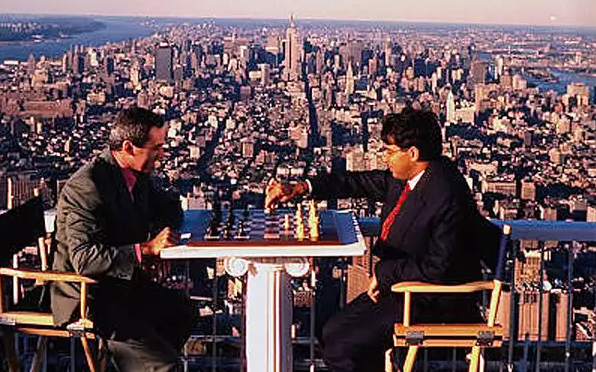
There was a 20-game match played in the 1995 chess world championship between then-world champion Garry Kasparov and Indian powerhouse Viswanathan Anand. (Notably, this match was played at the top of the World Trade Center in New York City.)

In that chess match, the two men played to a draw in each of the first eight games. In the ninth game, Anand won. Kasparov was now down one full game, however, he would go on to win four of the next five games and, ultimately retain his world championship with a final score of 10.5 to Vishy’s score of 7.5.

The loss did not matter because, in the context of the 18 games they played, Kasparov was more effective–despite having a moment of loss.

When we have a bad day, look at the whole week. One bad day in a good week isn’t that bad. One bad week, when we’ve had a great month, is easier to swallow. A slow month of work isn’t so bad when we’ve had the best year we can remember.

However, if we don’t “zoom out” and look at a larger pool of data, we tend to obsess over a bad event, bad day, bad season, etc…

Life has seasons, some up, some down. But if we stay the course and live a good and valuable life we can weather the storms and minimize the negative impact. The losses don’t define you, it’s how you recover from the losses and continue working that matters.

The Region-Beta Paradox

It is easier to live an uncomfortable life than do the work to make life better. We will choose to remain in a situation that is bad, but passable, rather than working hard enough to elevate our life to a new level.

When something is bad, but not catastrophic, we have a strange tendency to accept the difficult position rather than fight our way to a more satisfactory one.

I remember reading an author quite a while ago (I can’t remember who it was) that said we make lasting changes in our life most often when we endure some great emotional event.

This hypothesis suggested by my mystery author reminds me of a phenomenon called the “region-beta paradox.” This is the idea that people often recover faster from more difficult or traumatic experiences than from less difficult ones.

The idea is that the human body produces a stronger defense against more traumatic events, thus the person can handle major stressful events in a much more capable manner than less stressful events.

This major reaction is the agent of change and, I think, can be applied to most parts of life.

You will stick with a job that is just OK if you’re able to make ends meet. You will stick with that mediocre job when you could go out and hunt down a better job because finding a new job involves risk, stress, and hard effort.

However, if the job is horrible or doesn’t pay enough to cover your bills, you feel forced to break out and find a better situation.

The more dramatic situation forces you to trigger the systems that respond with action. Taking action results in a better situation, despite the short-term discomfort. Taking action is virtually always the correct answer to the question.

There is a reason nagging injuries nag, but the broken leg heals in eight weeks. The major trauma is effectively corrected because we reacted with major action (i.e. get to the hospital and let the professionals fix you up.)

When life is difficult and you aren’t making the change you should, it is good when things go from bad to worse. It is from the “worse” that you will summon the appropriate response to change your life, business, and conduct for the better.

It is better to suffer short-term pain than sleep-walk through comfortable but unsatisfying mediocrity for your entire life. Embrace the pain and work harder than you ever have. Learn and grow from the bad situation. It only gets better if you make it better. So work on making it better.

Anxiety of the future cripples the present

When I lose focus on my larger plans for the future, I lose sight of the goal on the horizon.

When I lose sight of the goal on the horizon, I lose the clarity I have in my day-to-day work.

When I lose my clarity, I become a much, much less effective worker. This happens more acutely with my personal work because I need to do the daily work, but I also need to do the planning and writing the to-do list for my work each day.

When I become uncertain of the future or I lose sight of my goals, writing that daily too do list becomes much more of an exercise in scheduling busy work rather than the work that moves my business forward.

I’ll easily spend hours doing email and organization while ignoring the deep intellectual work that pushes my business forward.

Being anxious about the future cripples the present. You lose clarity in what needs to be done, you lose the courage to do it, and you pick yourself apart for these daily failures.

It becomes a self-fueling cycle that feels impossible to break free of. One major key to overcoming this is to see what you’re doing and prioritize planning and ensuring you keep a crystal clear picture of your future and your goals. Take it with your hands and don’t fear it.

The thrill of victory

To be the best, you don’t have to beat the best. To be the best, you must hate losing more than you are afraid of losing. Hate losing, don’t be afraid of it. Fear doesn’t serve you. Fear is something that can paralyze us and keep us from doing what needs to be done. But a hatred of losing motivates us to practice hard and put in the time to win.

Nobody is impressed with what you have

Money is a funny thing. We all treat it a bit differently, but kind of the same.

We don’t look at the fancy things other people have and think that they are cool people whom we should have huge respect for. We usually look at what they have and, if we consider the expense of it at all, think that other people would think that we are cool if we had the fancy car, the big house, the expensive vacation, etc…

The fancy car, the huge house, and the expensive vacations don’t make people respect or admire you. Expensive stuff doesn’t do that. Usually, people will feel less comfortable around you or harbor some kind of envy. Expensive stuff is not worth it if you’re trying to impress people or gain respect. People are too busy thinking about themselves to care.

If it is respect and admiration that you seek, don't buy more fancy things. Instead, practice being more humble, kind, and helpful. That takes more time and effort than buying a fancy car or a huge house. But you will gain real respect and admiration, and you will gain it from people who are worth having the respect of.

At first you must believe

If you believe that you’re able to do something, you will be able to do it. Those who can do, do because they first believed that they could. Those who don’t believe, cannot and will not.

Dreaming big

Don’t criticize other people for dreaming big. It’s how real change takes place. Most big dreams never come to fruition whether you support them or not. But big changes and spectacular advances don’t come by the ones who dream small.

So bad, yet still some good

There is no book so bad that some good cannot come of it. There is no person so bad that no good can be learned from them. There is no catastrophe so horrendous that some good cannot also be extracted from it.

Talent working hard? Working hard is a talent.

They say that hard work beats talent when talent doesn’t work hard. I think that hard work is a talent. Hard work is something that you can get better at. The ability to focus, undisturbed, for long periods of time to study a technical topic, or to practice an artistic skill is itself a talent.

If hard work was so easy, everybody would do it. But some people have the self-discipline to dedicate time to getting better at working hard.

Push yourself to practice, study, and work hard. Cultivate your ability to work hard and then apply that practice and study to areas where you have some natural talent and you can accomplish great things.

Learning everything (and doing it so well that they think you’re lying.)

I’ve found that learning many different things is as rewarding as it is frustrating. I love learning new things and the process of learning might be one of my favorite things on earth.

On the other hand, when you are not a specialist in one specific area, two things happen: 1.) They assume that you are not an expert in anything. 2.) They don’t know how to use your talents (i.e. hire you) because you are not stuck in a specific niche.

So what is a person to do who wants to learn everything? I don't want to believe that the answer is to choose to learn less and become less talented. So for me, I’m going to continue trying to learn as much as I can while diving deep into specific interests that benefit me intellectually and in business. When I write a book about my life, it will be a book about the world and the small part I played in that. So I must learn about the world.

To learn you must have had a strong upbringing that taught you to keep your mind open to new ideas, you need to find strong resources (white papers, books, documentation, courses, etc…,) you must seek out the best tools to help you work with the knowledge as you learn, and lastly, you must take the knowledge into the real world and test it.

You get better at chess, at drawing, at coding, at photography, at writing, at speaking, at anything by learning a little and ripping off the training wheels, and learning from the mistakes you make.

For example, write your own code, don’t just follow coding tutorials. Real learning comes from having to apply skills in the real world in all of it’s dynamic and fluid beauty.